
Going back to school often means needing to take things from the digital world and connect them to the analog. Need sound? Need printouts? John F. Braun and Dave Hamilton have some Cool Stuff Found for you! Then it’s on to troubleshooting external disks (including APFS), cable modem advice and what to do with an extra Mac mini. All this and more, just press play!

Nix Mini Color Sensor: $58.65 with Labor Day Coupon Code
We have a deal on the Nix Mini Color Sensor. This device senses color so you can match it to one of 31,000 brand name paint colors. If you’re looking for digital color matching, it will also give you the RGB, HEX, CMYK, and LAB colors. The Nix Mini Color Sensor is $69 through us, but if you use «LABORDAY15» (without the quotes) at checkout, you’ll save 15%. That brings it down to $58.65. Cool, yeah?
Smart TVs Could Get Smarter About Tracking You
It’s estimated that smart TVs will make up 70% of televisions shipped this year. This will give companies new data on the shows we watch and how long we watch them, which means better TV ad targeting.
Typically, TV and app makers say they don’t collect your data unless you’ve opted-in to share it, and what data they share isn’t linked to any personally identifiable information, but to an identifier that connects to a wealth of other data about you. In any case, Navin and other TV techies generally like to emphasize all that you get in exchange for turning over your viewing data. Samba’s software, for instance, can recommend shows for you to watch based on what you’ve already seen.
Can This California Privacy Law Bring Back Net Neutrality?
On Thursday, the state’s State Assembly voted 58-17 on a California privacy law called S.B. 822. It would implement the strongest net neutrality provisions in the U.S.
Here’s where it goes above and beyond the policy developed under the Obama administration: The bill also bans zero rating, which allows service providers to charge customers for data use on some websites but not on others. If you want to dive deeper into the nitty-gritty, take a look at the bill here.
How Google Will Win the War Against Adblockers
Technology or not, at the end of the day Google is an advertising company. So how is it going to make money when a large percentage of people are blocking ads? Nothing short of offline surveillance.
Alphabet Inc.’s Google and Mastercard Inc. brokered a business partnership during about four years of negotiations, according to four people with knowledge of the deal, three of whom worked on it directly. The alliance gave Google an unprecedented asset for measuring retail spending, part of the search giant’s strategy to fortify its primary business against onslaughts from Amazon.com Inc. and others.
Google made a secret deal with Mastercard to track your purchases in the offline world. And I’m sure it will move to partner with other banking institutions as well. This is how it will win the war against adblockers.

Interview with Joel Duggan from The Citadel Cafe Podcast - TMO Daily Observations 2018-08-31
Joel Duggan from the Citadel Café podcast joins Jeff Gamet to talk about digital art, comics, his creative process, and Battlestar Galactica.
Check out this Tablet/Phone that Rolls Up Like Scroll
Let me state right up front that this thing is useless, a bad idea in search of a problem. I don’t care, because it’s also super cool and a herald of some crazy cool stuff yet to call. That out of the way, here’s the Magicscroll (via TechCrunch), a research product from scientists at Canada’s Queen’s University Human Media Lab. It’s part smart-ish phone, part tablet, and part wonky, because it rolls into a cylinder, thanks to a 7.5” 2K resolution flexible display. Watch the video, and you can see how they use the ends to navigate and unroll the screen to use it as a tablet. Ish. Here’s why I’m excited about it: it’s that rolled up display. While «displays» are eventually headed towards holographic projectors (I’m telling you now), an intermediary step is going to be displays that roll up into tight little cylinders we can take with us. Again, I’m telling yo now. The Magicscroll is an early step towards much more useful iterations, and you have to start somewhere. Also, I love to see anyone trying to think about different ways to do things, even if those ways seem absurd. You know, like this one. So, check it out!

Syncwire UNBREAKcable MFi-Certified Lightning Cable: $10.99
Check out the Syncwire UNBREAKcable, an MFi-Certified Lightning cable bend-tested for 30,000 charging cycles. It features a TPE jacket exterior and tinplate-wrapped inner wires. And it’s $10.99 through our deal.
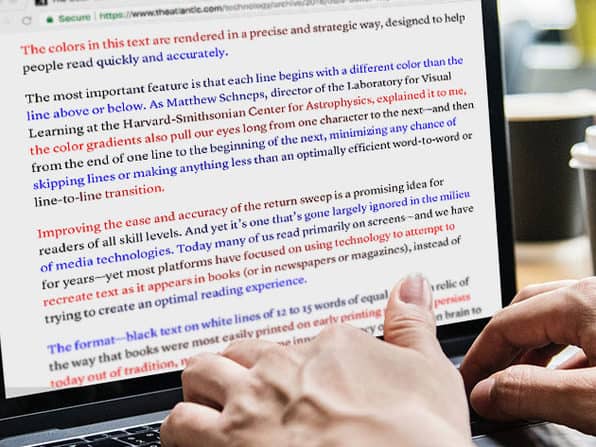
BeeLine Reader Lifetime Subscription: $29.99
We have an interesting deal for you on BeeLine Reader, a speed reading tool that works on Chrome or Firefox on your Mac or PC. According to the company, «this speed reading tool applies an eye-guiding color gradient to your text, with the color at the end of one line matching perfectly with the beginning of the next.» The deal is for a lifetime license good on one browser for $29.99. If you choose the 5-browser version ($39.99), the company will donate five licenses to low-income students.
Middle East Espionage Involves Hacking Macs
A hacking team called WindShift has been responsible for hacking Macs for the past couple of years. They target certain individuals working in government departments in the Middle East.
Karim, a researcher at cybersecurity company DarkMatter, said the attackers had found a way to “bypass all native macOS security measures.” Once they’d penetrated those defenses, the malware would exfiltrate documents of interest and continuously take screenshots of the victims’ desktops. The attacks have been ongoing from 2016, through to today, the researcher added.
Scary stuff, and it sounds like whatever vulnerabilities WindShift is finding affect all Mac models. That being said, these are highly targeted attacks, so the rest of us probably don’t have to worry.


