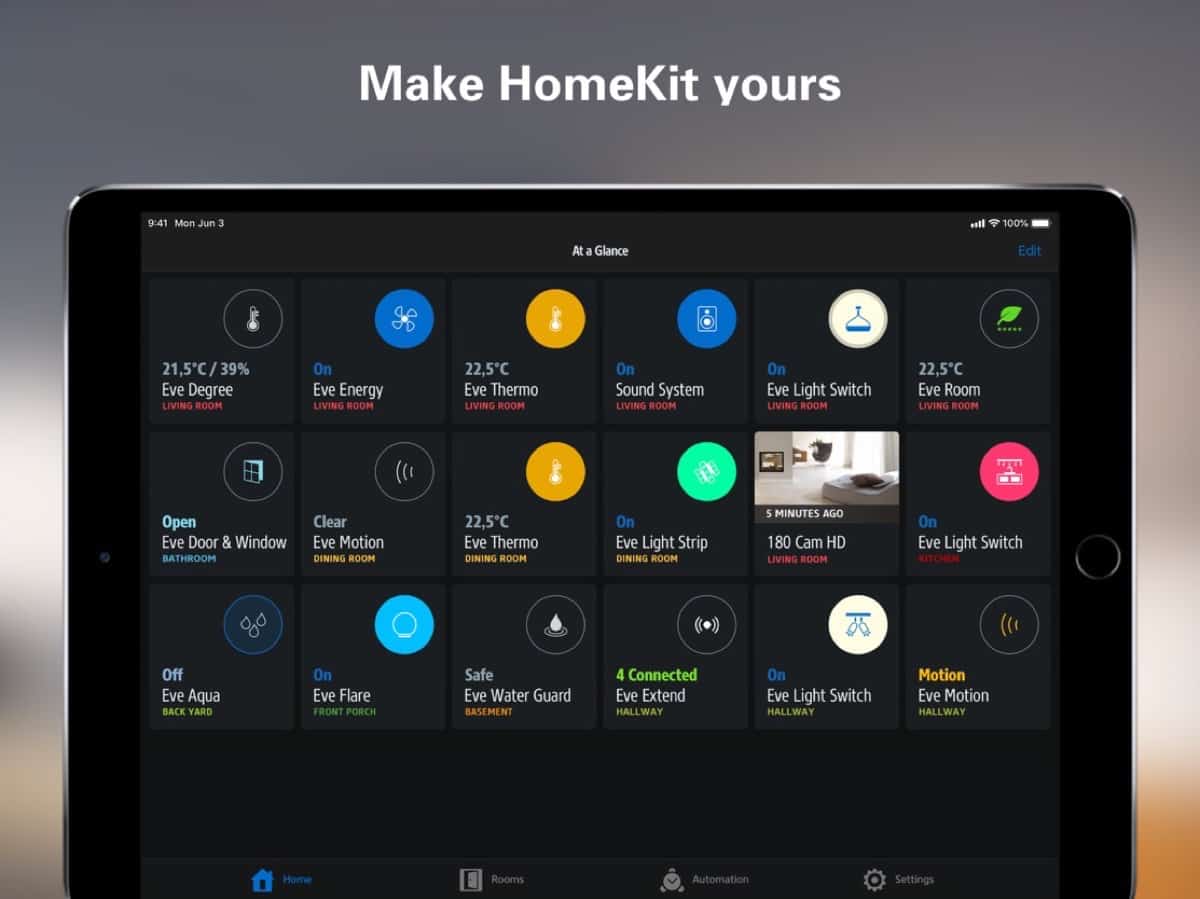
Eve 4.2 Update Improves Support for HomeKit Cameras

Version 4.2 of Eve’s app brings automatic syncing of Eve settings across your iOS devices, improved support for HomeKit cameras, redesigned appearance controls for your Rooms, and more. The company is also preparing for the release of Eve Cam which will starting shipping May 2020.

Eve Cam exclusively taps into HomeKit technology to deliver state-of-the-art privacy by design, with no parallel data sharing, no account or registration, and no tracking or profiling. And even when you’re at home and have disabled all video features, you can still use Eve Cam as a full-blown motion sensor to control your other HomeKit-enabled accessories.

App Store: Eve for HomeKit – Free

Portable Second Monitor for Your MacBook: $179.35

Our deal for the Mobile Pixels DUEX Pro portable dual monitor is back. This device is a portable monitor designed to be hung off the side of your MacBook or other laptop. It’s a 1080p resolution display, and it works through USB-C. It’s $249.99 through our deal, but coupon code SAVEDUEXPRO brings it down to $179.35 at checkout.

How Apple and Google Apple Will Get us to Use COVID-19 Contact-Tracing Tech

One of the big discussions around Apple and Google’s partnership on COVID-19 contract-tracing apps is how they were actually going to get people to use them. Casey Newton of The Verge joined a call in which the firms explained that the important is the second phase – baking the technology into a device’s operating system so people don’t have to install a health authority app.

The companies said that by phase two of their effort, when contact tracing is enabled at the level of the operating system, they will notify people who have opted in to their potential exposure to COVID-19 even if they have not downloaded the relevant app from their public health authority. My understanding is that the operating system itself will alert people that they may have been exposed and direct them to download the relevant public health app. This is significant because it can be hard to get people to install software; Singapore saw only 12 percent adoption of its national contact-tracing app. Putting notifications at the system level represents a major step forward for this effort, even if still requires people to opt in.

WeChat Poses Threat to Apple in China

WeChat, a mix of a messaging, social media, and e-payment app from Tencent, seems to flout App Store rules. But it is so ubiquitous in China that Apple has to let this slide. AppleInsider, picking up on reporting from The Information, looked at the problems this could pose for Apple in the country.

WeChat itself is an app, but within it, users can open what maker Tencent calls mini-programs. Right from the start, it appears that Apple recognized the potential for mini-programs to offer App Store-style services without playing by App Store rules. According to The Information, a team from Tencent visited Apple around 2017 specifically to reassure Tim Cook that mini-programs were not apps. That mini-programs were not a threat. The argument then was that these mini-programs were limited in functionality and did not even attempt to compete with full-blown apps. Now, however, they do. Some mini-programs include live video streaming, and even augmented reality.

Zoom: Don’t Want to Get Routed Through Chinese Servers? Fork Over Your Cash

One of Zoom’s controversies is how it routes some of its network traffic through China’s servers. If you’re privacy conscious, you can opt out of specific data center regions starting April 18. But this is only for paying customers.

This feature gives our customers more control over their data and their interaction with our global network when using Zoom’s industry-leading video communication services.

I can’t say I agree. It’s not about making privacy a paid feature, it’s that Zoom is exploiting its own insecurity to create a paid feature. Next step: Making end-to-end encryption a paid feature, and leaving free users to fend for themselves.