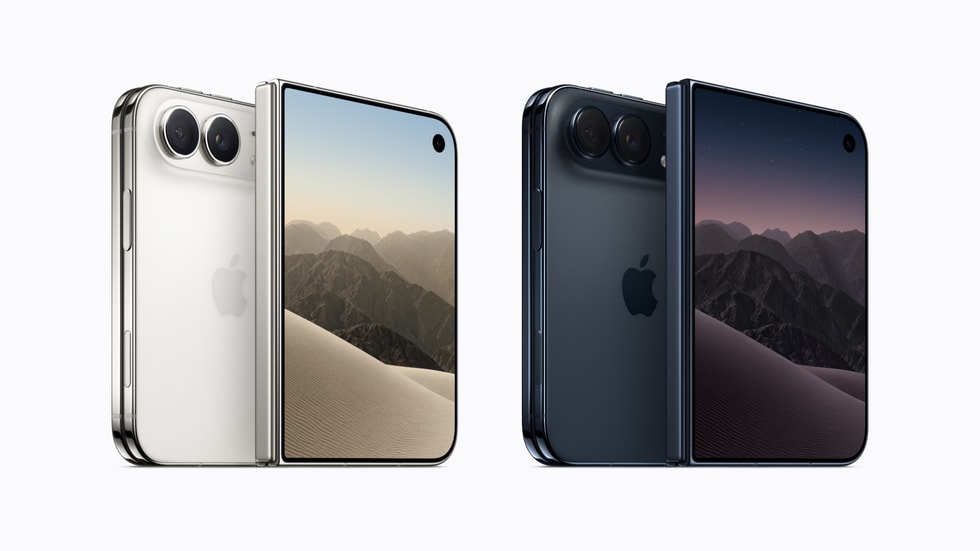
Apple’s U.S. online store lists iPhone Duo at $1,999 for 256GB, $2,199 for 512GB, $2,599 for 1TB and $3,199 for 2TB. Apple offers every capacity in both Night Sky and Star White at the same price, and the store page shows the phone available starting October 23.

That puts $1,200 between the cheapest and the most expensive iPhone Duo, and the only thing you get for that money is storage. Our iPhone Duo pre-order story covers trade-in and leasing. This piece is about picking the right capacity before you check out, because storage is fixed once you buy.
The four tiers at a glance
Each step up doubles the storage. The price jumps grow at each step too, but the cost per gigabyte falls at the top of the range.
Don’t miss the best of The Mac Observer
Set us as a preferred source and our Apple reporting ranks higher in your Google Search results and Discover feed — one tap, no account changes.
| Storage | U.S. price | Step from the tier below | Our math: cost per added GB |
|---|---|---|---|
| 256GB | $1,999 | Base model | Not applicable |
| 512GB | $2,199 | $200 for 256GB more | About 78 cents |
| 1TB | $2,599 | $400 for 512GB more | About 78 cents |
| 2TB | $3,199 | $600 for 1TB more | About 59 cents |
In relative terms, 512GB costs about 10 percent more than the base model for twice the space. The 2TB model costs 60 percent more than the 256GB model.
iPhone 18 Pro, which starts at $1,199, offers the same four capacities, so the choice works the same way on either phone. On iPhone Duo, each step simply sits on top of a higher starting price.

How much space you actually get
Apple’s store footnote is specific about what the system takes. “A standard configuration uses approximately 12GB to 24GB of space, including iOS 27 with its latest features and Apple apps that can be deleted,” Apple says.
The same footnote adds that “Apple Intelligence on-device models use approximately 7GB of space and can be deleted if Apple Intelligence is turned off.” Apple apps that can be deleted use about 4.5GB, and you can download them back from the App Store.
By our math, that leaves roughly 232GB to 244GB for your own photos, videos, apps and downloads on the 256GB model before anything else. Apple notes that available space “varies due to many factors” and can change with software version and settings, so treat that as a starting point.
What fills an iPhone Duo faster
Two things about iPhone Duo push storage harder than a typical iPhone. The first is the camera. Apple’s specs list 4K Dolby Vision video recording at up to 120 fps on the Fusion Main camera, plus super-high-resolution photos at 24MP and 48MP. Higher resolution and higher frame rates mean bigger files, and long 4K clips at 120 fps are where a 256GB phone fills up.
The second is the inner display. A 7.6-inch folding screen makes iPhone Duo a better device for watching downloaded shows on a flight, reading large documents and playing big games. Each of those habits adds local files that a smaller phone owner might stream instead.
Which tier to pick
- 256GB ($1,999): Right if you stream most of your video and music, keep your photo library in iCloud and shoot 4K only now and then. The system footprint still leaves well over 200GB.
- 512GB ($2,199): Our pick for most iPhone Duo buyers. If you are already spending $1,999 on a foldable built for video and multitasking, $200 for double the space is the best value step on the ladder.
- 1TB ($2,599): For people who film a lot of 4K at high frame rates, keep large offline libraries of shows, music or games, or want years of photos stored on the phone without managing space.
- 2TB ($3,199): For creators who shoot long 4K Dolby Vision sessions away from a computer and never want to offload in the field. The $600 step from 1TB has the lowest cost per gigabyte, but it is still $600.
Ways to stay on a smaller tier
iPhone Duo’s USB-C connector supports USB 3 at up to 10Gb/s, according to Apple’s specs, so moving video to a Mac or an external drive is quick. If you film in bursts, offloading after each shoot can make 256GB or 512GB work.
Cloud storage is the other route. Apple’s press release says new and qualified returning subscribers who buy iPhone Duo can get three months of Apple One free, and Apple One bundles services including “up to 2TB of iCloud+ storage.” That trial is a good way to test whether keeping photos in iCloud lets you skip a tier.
You can compare all four configurations and both colors on Apple’s iPhone Duo store page.