
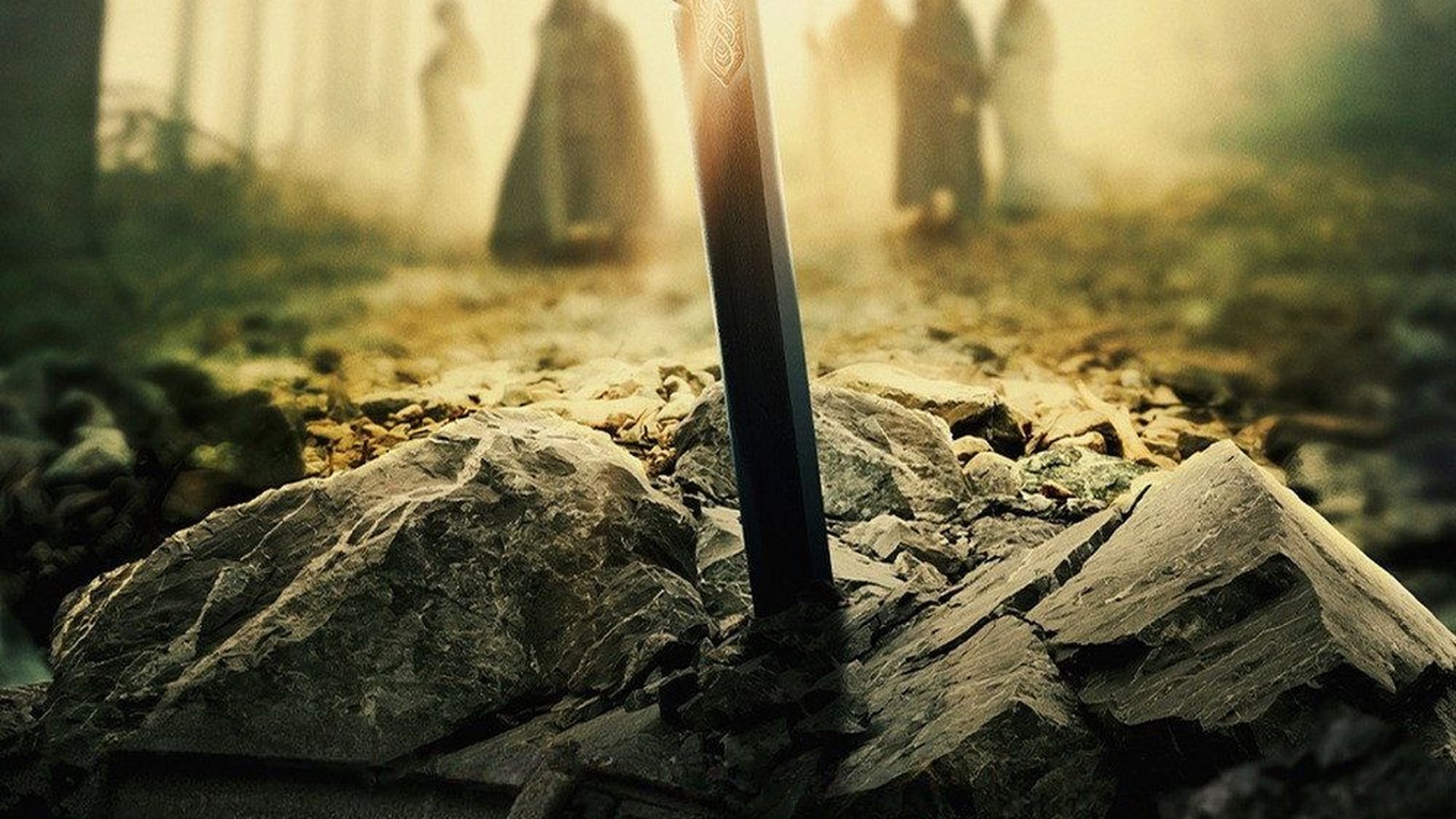
The Pendragon Cycle: Rise of the Merlin ends by placing the Sword of Britain in a stone because Merlin is preparing a test of legitimacy, not hiding a weapon for its own sake. The final image points forward to an Arthurian future in which authority must be recognized rather than simply seized.
The show’s official press material describes its closing image as the moment every version of the legend reaches toward: a sword driven into a stone. It is a deliberate ending that transforms Merlin’s story into the beginning of Britain’s next one.
- Series: The Pendragon Cycle: Rise of the Merlin
- Setting: post-Roman Britain
- Final image: sword in a stone
- Genre: Arthurian fantasy drama
The sword is a promise about the future
The official press kit frames the series around a Britain in transition, with old gods fading, Christianity taking root and invaders threatening divided tribes. In that setting, a sword in stone is more than a familiar legend reference. It creates a future standard for whoever claims to unite the country.
Don’t miss the best of The Mac Observer
Set us as a preferred source and our Apple reporting ranks higher in your Google Search results and Discover feed — one tap, no account changes.
Merlin’s decision therefore carries a political meaning. Power in a fractured Britain cannot rest only on lineage, force or the approval of one faction. The sword presents an answer that can be witnessed: the person able to draw it has a claim others must confront.
Merlin becomes a kingmaker
Arthurian tradition often uses Merlin as the figure who protects Arthur’s path before Arthur can understand it himself. The ending works in that tradition. Merlin does not take the sword for his own rule. He makes a choice designed to outlast him and to identify a leader at the point Britain needs one.
That also explains why the image closes a story called Rise of the Merlin. His rise is not merely about acquiring power or knowledge. It is about learning what to do with influence when the future depends on another person’s chance to lead.
The stone turns destiny into a public challenge
A hidden sword would only preserve Merlin’s secret. A sword fixed in a stone creates a challenge that can reshape the political order. It asks every ambitious claimant to fail in public until the right person succeeds. The ending is therefore an act of faith in a future ruler and an invitation for Britain to recognize him.
The ending is also a clean way to connect the series’ earlier spiritual conflict to the better-known Arthur story. Britain’s crisis does not disappear because Merlin has learned more about his own power. It requires a new kind of leadership, and the sword becomes the visible symbol of that unresolved need.
Merlin’s act is patient rather than triumphant. He cannot force unity, but he can arrange the moment when the country is asked to see it in someone else.
Do you read Merlin’s final act as strategy, prophecy or both? Join the discussion below.




Discussion