
Calendar app Fantastical updated to version 3.2 which adds support for iOS 14 widgets, iPadOS Scribble, and bug fixes.
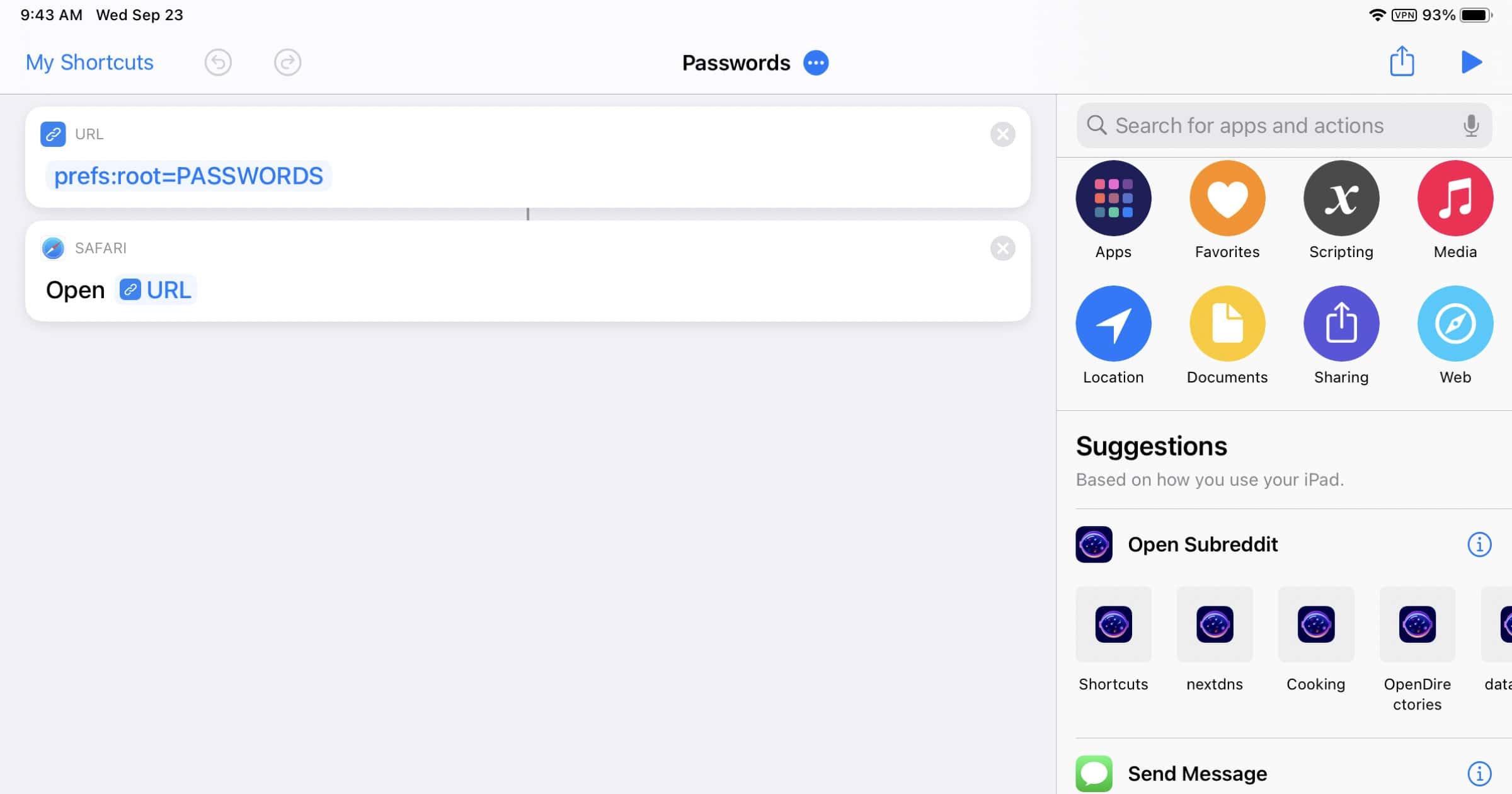
Quickly Access iCloud Keychain With This Apple Engineer’s Shortcut
Ricky Mondello works on app and website authentication as well as password management at Apple. They recently created a shortcut that lets you quickly access iCloud Keychain, so instead of opening Settings and scrolling down to tap on Passwords, it’s a one-tap method to directly open the Passwords section. Separately from that, this is also something you can do yourself using the Settings Shortcut Generator. You can quickly jump to a variety of different places within Settings. One that I recently created is jumping to Settings > Privacy > Photos to manage app access to photos.

Discover Your Place in the Universe With the Kurzgesagt App
Kurzgesagt is a science channel on YouTube that creates education videos for people. They recently partnered with Wait But Why to create the Universe in a Nutshell app. It lets people explore size by zooming between scales of 10^-35 meters to 10^26 meters (atomic scale to universe scale). It’s also filled with science facts that you can find by tapping on the objects you see. App Store: US$2.99

iPadOS 14: How to Fix iPad Books 2-Column Issue
Apple’s Books app in iPadOS OS 13 and iPadOS 14 has an interesting interface quirk that can display your book’s text in two narrow columns like a newspaper, and Bryan Chaffin has the quick fix.

Security Camera, Wearable Body Camera, or Car Dashcam: $64.99
We have a deal on TOKK CAM C2, a tiny camera that can be used as a security camera, a wearable body cam, or a dashcam for your car. With this portable, ultra-compact Wi-Fi camera, you can instantly stream and/or record crystal clear video in 1280x720P. And all of is controlled through an iOS or Android app. This device is $64.99 through our deal.

Create iOS 14 Widgets With the “Widgetsmith’ App
Widgetsmith lets you create iOS 14 widgets and customize them to suit your needs and Home Screen theme. The app includes a variety of widget categories like weather, calendar, timezone converter, and others. Widgets can even by scheduled to appear on your screen following rules you define. App Store: Free (Offers In-App Purchases)

Linksys Velop Tri-Band Routers Now Support HomeKit
Linksys Velop Tri-Band Routers now support Apple’s HomeKit through a free update available in the Linksys app.
Through HomeKit, Velop users can choose to firewall off HomeKit accessories to prevent them from communicating with other WiFi devices on a home network and untrusted internet services to prevent hacking attempts and provide better security for connected home devices.
HomeKit-compatible Velop Tri-band model numbers that work with HomeKit include A03, WHW0301, WHW0301B, WHW0302, WHW0302B, WHW0303, and WHW0303B.
Good news for owners of these routers.

Apple Orders ‘High Desert’ Series Starring Patricia Arquette
Apple has ordered a comedy series called “High Desert” that stars Academy Award winner Patricia Arquette and directed by Ben Stiller.

Apple Updates iWork Apps With Support for iPadOS 14 ‘Scribble’
Apple has updated Pages, Numbers, and Keynote with new updates, the most notable of which is support for the iPadOS 14 Scribble feature.

Series 6 Watch Teardown, Love for Ted Lasso – TMO Daily Observations 2020-09-22
John Martellaro and Bryan Chaffin join host Kelly Guimont to discuss a Series 6 Watch teardown, plus Bryan and Kelly’s love of Ted Lasso.