
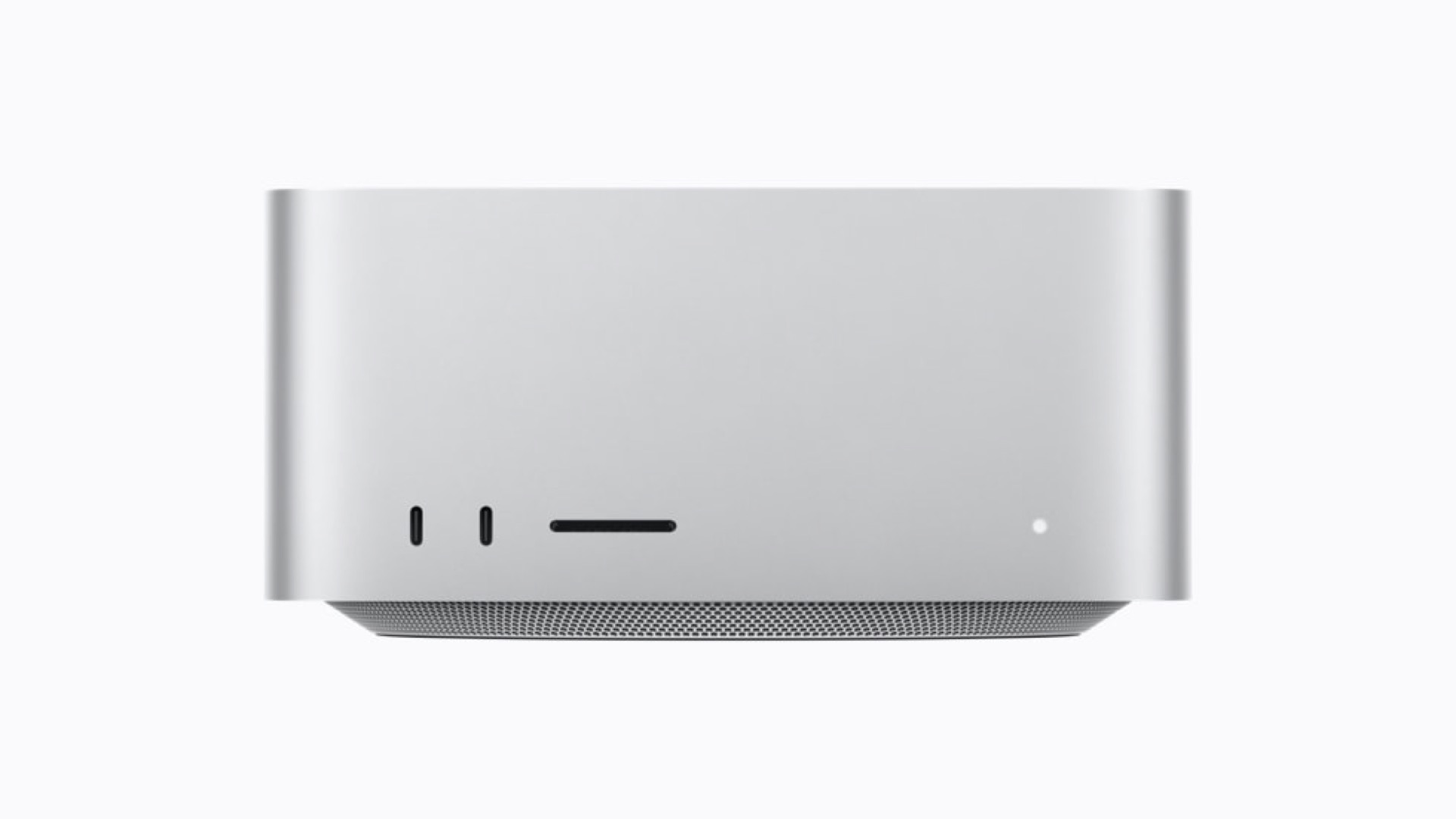
The M5 Max chip gets top billing in Apple’s 2026 Mac Studio, but its faster internal storage may be the upgrade professionals notice most often. Early review testing points to a much larger SSD improvement than the desktop’s familiar exterior suggests.
Roman Loyola’s Macworld review describes SSD performance as the central story after testing an upgraded Mac Studio with an 18-core M5 Max, 40-core GPU, 128GB of unified memory, and a 4TB SSD. Loyola says the gain is substantial enough to be felt by owners moving from the M4 Max or M3 Ultra generation.
Apple’s announcement supports the broader finding. The company says a next-generation SSD architecture delivers storage performance up to twice as fast as the previous Mac Studio when loading projects, transferring files, and loading large language models.
Don’t miss the best of The Mac Observer
Set us as a preferred source and our Apple reporting ranks higher in your Google Search results and Discover feed — one tap, no account changes.
Why the SSD gain matters
A faster processor only helps the work it is asked to perform. Storage speed affects how quickly large source files reach the CPU and GPU, which makes it especially relevant to video, photography, development, and local AI workflows.
The rest of Macworld’s testing found useful but less dramatic generational gains. Its M5 Max sample scored 22 percent above M4 Max in Geekbench 7 multicore testing and 8 percent higher in single-core testing. Cinebench 2024 showed a 33 percent GPU improvement over M4 Max.
Those results add practical context to Apple’s new Mac Studio specifications. Buyers choosing between chips can also review our M5 Max and M5 Ultra comparison.
One important limit remains
The RAM and SSD are not user-upgradeable, so storage capacity still needs to be chosen at purchase. The review also tested a 4TB configuration, which means buyers should not assume every capacity will post identical benchmark numbers until more retail systems are measured.
The new Mac Studio reaches customers and stores on September 22. The highest-end configuration with 512GB of unified memory will follow in late October. Our coverage of the first M5 Ultra Geekbench result offers another early performance data point, though it measures CPU speed rather than storage.




Discussion