
Apple released new version of its operating systems and shared the security content for macOS Big Sur 11.4.
Security

‘Have I Been Pwned’ Open Sourced, Partners With FBI
The popular service Have I Been Pwned has made its code open source, and it’s also partnering with the FBI. The agency will send compromised passwords discovered during investigations.
Why is the FBI getting involved? Because Bryan A. Vorndran, the FBI’s Assistant Director, Cyber Division, said, “We are excited to be partnering with HIBP on this important project to protect victims of online credential theft. It is another example of how important public/private partnerships are in the fight against cybercrime.”

DHS Releases Cybersecurity Rules for Pipeline Operators
Today, the Department of Homeland Security’s Transportation Security Administration (TSA) announced a Security Directive for critical pipeline companies.
The Security Directive will require critical pipeline owners and operators to report confirmed and potential cybersecurity incidents to the DHS Cybersecurity and Infrastructure Security Agency (CISA) and to designate a Cybersecurity Coordinator, to be available 24 hours a day, seven days a week.
It will also require critical pipeline owners and operators to review their current practices as well as to identify any gaps and related remediation measures to address cyber-related risks and report the results to TSA and CISA within 30 days.

WebKit Flaw Crashes Safari, Could Lead to Further Exploits
A WebKit flaw on iOS and macOS can cause Safari to crash and could lead to further malicious attacks.
The vulnerability stems from what security researchers call a type confusion bug in the WebKit implementation of AudioWorklet, an interface that allows developers to control, manipulate, render, and output audio and decrease latency. Exploiting the vulnerability gives an attacker the basic building blocks to remotely execute malicious code on affected devices.

1Password Browser Extension Now Supports Touch ID, Windows Hello
AgileBits announced on Wednesday that its 1Password browser extension supports biometric unlocking for Touch ID and others.

Flaw Found in M1 Chip Lets Apps Secretly Communicate
A security researcher found a flaw baked into M1 chips that could let any two apps to secretly exchange data.

LastPass Introduces Improved Multi-Factor Authenticator App
LastPass by LogMeIn announced on Wednesday that it enhanced its mobile authenticator app and integrates with VPN providers Cisco, Palo Alto Networks, and OpenVPN for businesses. However, the authenticator app is available to all LastPass users.
With this update, the LastPass Authenticator will offer a refreshed user interface that now offers search functionality to reduce user complexity and streamline the authentication experience.

Major Browsers Vulnerable to Cross-Browser Tracking Exploit
Chrome, Firefox, Safari, and Tor are vulnerable to a type of cross-browser tracking that can identify users.

Did the Government Take Down the DarkSide Ransomware Group?
DarkSide is the group behind the ransomware attack affecting Colonial Pipeline, and recently said it lost control of its web servers.

What’s Wrong With AirTags? Stalkers and Security
One report about AirTag on Thursday show that more security researchers are exploring the device, and another says it is a “gift to stalkers.”

President Biden Signs Order to Improve U.S. Cybersecurity
After the attack on Colonial Pipeline, President Biden has signed an executive order to improve the nation’s cybersecurity.
The executive order requires IT service providers to share certain breach information with the government, modernizes and implements stronger cybersecurity standards in the federal government, establishes security standards for development of software sold to the government and will create an “energy star” label so that consumers can better determine whether software was developed securely.

Security Researcher Hacks Apple’s ‘Find My’ Network
Researcher Fabian Bräunlein found that Apple’s Find My location network can be used to “upload arbitrary data to the internet.”
Being inherent to the privacy and security-focused design of the Find My Offline Finding system, it seems unlikely that this misuse can be prevented completely.

CIDA Warns of New Ransomware ‘FiveHands’
FiveHands has been around since January but was recently used in a successful attack against an unknown organization.
Attackers were targeting unpatched SonicWall Secure Mobile Access SMA 100 remote access products, for which patches were released in February. The publicly available tools the group users including the SoftPerfect Network Scanner for Discovery and Microsoft’s own remote administration program, PsExec.exe and its related ServeManager.exe.

Password Managers: How Do They Work? – TMO Daily Observations 2021-05-11
Andrew Orr and Bryan Chaffin join host Kelly Guimont dig deep into password managers, how they work, and why you need one.

Amazon Data Breach Exposes 200,000 Fake Reviewers
Security researchers at SafetyDetectives found an insecure ElasticSearch database that potentially uncovers over 200,000 fake Amazon reviewers.
These Amazon vendors send to reviewers a list of items/products for which they would like a 5-star review. The people providing the ‘fake reviews’ will then buy the products, leaving a 5-star review on Amazon a few days after receiving their merchandise.
Upon completion, the provider of the fake review will send a message to the vendor containing a link to their Amazon profile, along with their PayPal details.

Tor Exit Nodes Were Attacked in February 2021
A new report from Hacker News says that an unknown attacker managed to control over 27% of Tor exit nodes in February 2021.
“The entity attacking Tor users is actively exploiting tor users since over a year and expanded the scale of their attacks to a new record level,” an independent security researcher who goes by the name nusenu said in a write-up published on Sunday. “The average exit fraction this entity controlled was above 14% throughout the past 12 months.”

GitHub Adds Support for Security Keys Over SSH
GitHub announced on Monday that it enabled support for two-factor authentication security keys when members use them over SSH.
When used for SSH operations, security keys move the sensitive part of your SSH key from your computer to a secure external security key. SSH keys that are bound to security keys protect you from accidental private key exposure and malware. You perform a gesture, such as a tap on the security key, to indicate when you intend to use the security key to authenticate. This action provides the notion of “user presence.”
Rumbling with Gatekeeper — Mac Geek Gab 870
Apple’s protective engines usually do well at protecting our devices, but what happens when they go haywire? It’s time to Rumble, that’s what, and John and Dave are here to help! Listen as they answer your questions, share Cool Stuff Found, push out the Quick Tips and make it easy to learn at least five new things this week!

128 Million Apple Users Unknowingly Downloaded Malware in 2015
Emails published in the Epic v Apple trial on Friday revealed that 128 million users downloaded malware from the App Store in 2015.

Over 29,000 Databases Expose 19 Petabytes of Data
Many companies aren’t properly securing their databases, like the one I wrote about this morning. But we have some numbers. CyberNews quotes “29,000 unprotected databases worldwide exposing 19 petabytes (19,000 terabytes, 19,000,000 gigabytes, etc) of data.
To conduct this investigation, we used a specialized search engine to scan for open databases of three of the most popular database types: Hadoop, MongoDB, and Elasticsearch. While performing the search, we made sure that the open databases we found required no authentication whatsoever and were open for anyone to access, as opposed to those that had default credentials enabled.

Many Top VPN Apps Have Inaccurate Privacy Labels
An analysis of 49 VPN apps in the App Store shows that many of them have inaccurate privacy labels, and others didn’t have a label at all.

Finnish Mental Health Startup Vastaamo Leaked Patient Data
Vastaamo ran the largest network of private mental-health providers in Finland. William Ralston tells the story on WIRED, and how hackers used the data to threaten patients.
A security flaw in the company’s IT systems had exposed its entire patient database to the open internet—not just email addresses and social security numbers, but the actual written notes that therapists had taken. A group of hackers, or one masquerading as many, had gotten hold of the data.
What an incompetent company. No anonymization of patient records, no encryption of data. In other words, unfortunately common. Two developers hired at Vastaamo were even arrested in a previous security breach.
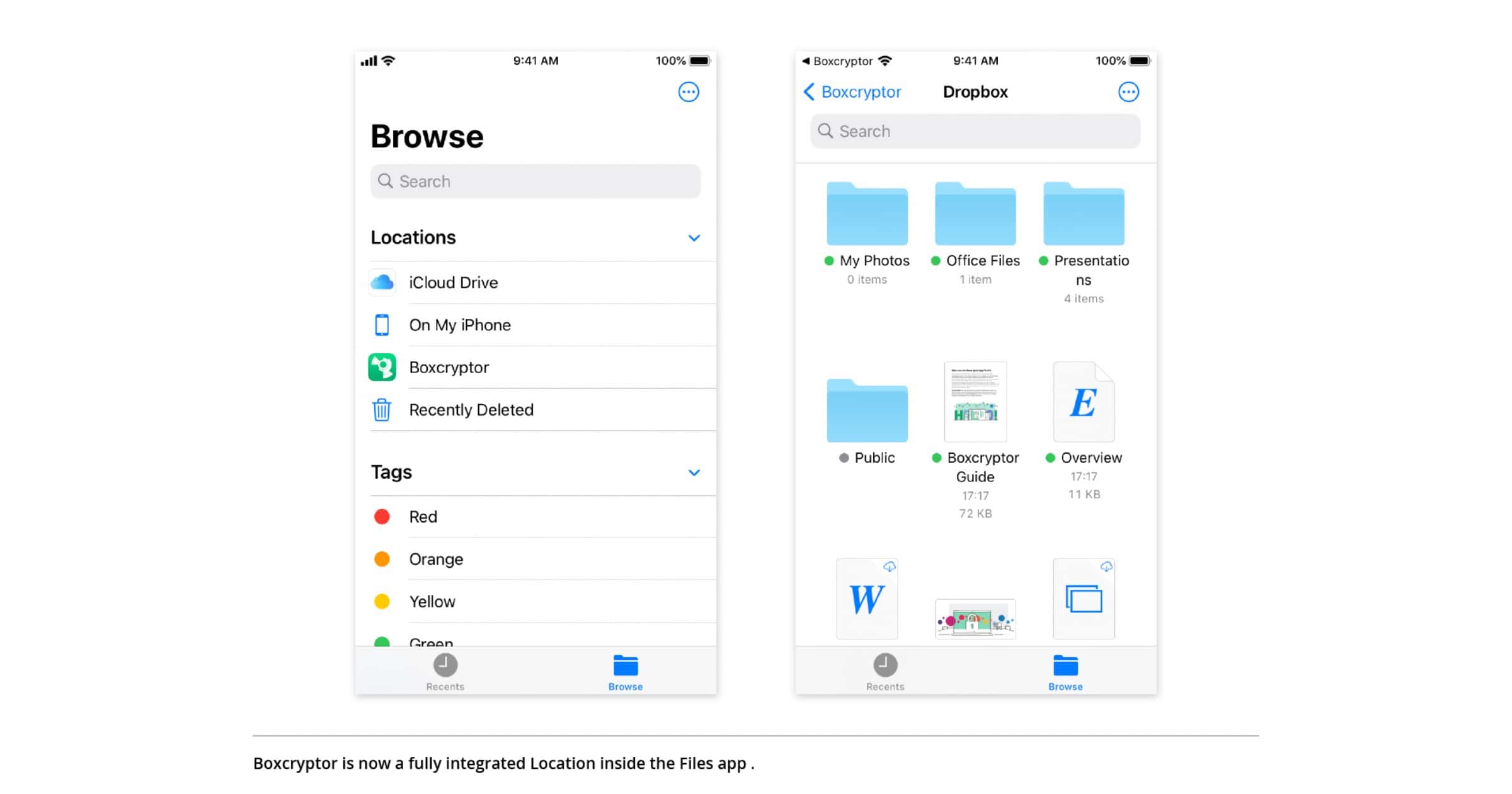
Encrypted Storage App ‘Boxcryptor’ Integrates Better With Files App
Boxcryptor received a major update for iOS and iPadOS that eliminates its own file browser. Instead, you’ll browse through your encrypted files completely within Apple’s Files app. Robert Freudenreich explains the decision: “By taking a ‘Files app first’ approach, we enable the best user experience for working with encrypted files in Apple’s Files app.” The integration with the Files app has been in place since iOS 11. But by eliminating the additional Boxcryptor-owned file browser, the Files app now becomes the exclusive file manager. For users, this primarily means an even simpler workflow.

IRS Asks For Help to Hack Hardware Cryptocurrency Wallets
The IRS is asking for help to hack into hardware cryptocurrency wallets that could be useful in criminal investigations.
The decentralization and anonymity provided by cryptocurrencies has fostered an environment for the storage and exchange of something of value, outside of the traditional purview of law enforcement and regulatory organizations. There is a portion of this cryptographic puzzle that continues to elude organizations—millions, perhaps even billions of dollars, exist within cryptowallets.