Apple has updated its App Review Guidelines so that content moderation rules explicitly cover nonconsensual intimate imagery, including imagery made with AI tools. In an October 16 developer post, Apple also said a new rule, 2.5.19, targets apps that misrepresent what they do during review and then change after approval, with removal from the App Store and the Apple Developer Program as the penalty.
Apple framed the changes as a tightening of standards it already enforces. Its post says pornographic material “has long been prohibited on the App Store,” including “nudification” apps “that create sexually explicit images of real individuals without their consent.” What is new is the wording that spells out who is responsible and what happens when they fail.
Guideline 1.2 now names AI content creation apps
Guideline 1.2 covers apps built around user-generated content. The revised text says these apps present particular challenges, “including intellectual property infringement, nonconsensual intimate imagery, and anonymous bullying,” and adds: “This includes social media, user-generated content platforms, and AI content creation apps.”
Don’t miss the best of The Mac Observer
Set us as a preferred source and our Apple reporting ranks higher in your Google Search results and Discover feed — one tap, no account changes.
Apple’s post describes the change this way: nonconsensual intimate imagery, “including imagery generated using AI tools,” is now content “that apps must proactively prevent and remove from their platforms.”
The four baseline requirements for these apps are listed in the guideline:
- A method for filtering objectionable material from being posted to the app
- A mechanism to report offensive content and timely responses to concerns
- The ability to block abusive users from the service
- Published contact information so users can easily reach you
The guideline now also says developers “who fail to implement appropriate safeguards or fail to remediate identified violations after notice may be considered in violation of the Developer Code of Conduct.” The guideline also states that “egregious or repeated behavior is grounds for immediate removal of your app from the App Store, and from the Apple Developer Program.”
Rule 2.5.19 goes after bait-and-switch apps
The second change deals with what Apple calls bait-and-switch. Its post describes apps “that misrepresent their purpose during review and only reveal harmful capabilities” once they are approved, with “nudification” given as an example.
Guideline 2.5.19 reads: “Don’t include any hidden, dormant, or undocumented features in your app; your app’s functionality should be clear to end users and App Review.” It continues: “Attempting to hide undocumented features in your app binary, such as through code obfuscation or other methods, is grounds for removal of your app from the App Store and termination of your developer account.”
Apple says the rule “clarifies long-standing policy on hidden, dormant, or undocumented features, formerly covered in Guideline 2.3.1.” The developer post gives an example of the conduct it covers: “adding features or functionality that weren’t included in the version of the app that was submitted to App Review.”
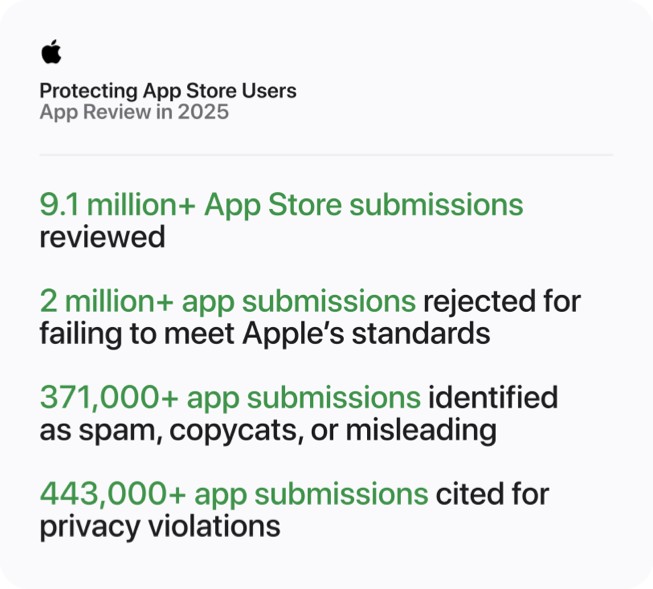
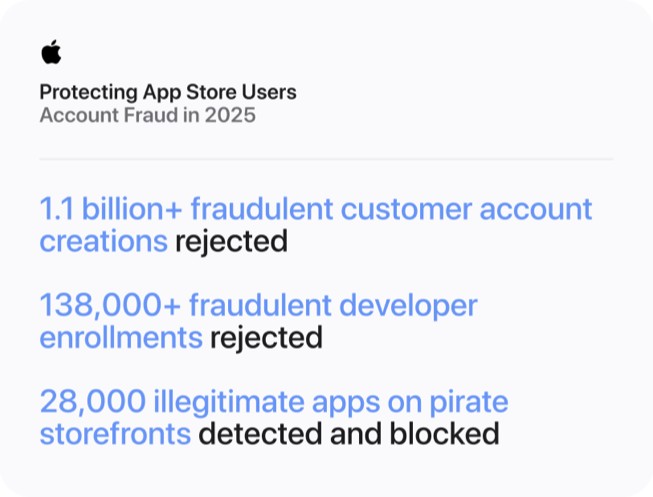
Apple’s own numbers show why it is singling this out. In its 2025 App Store fraud prevention report, Apple said apps “initially approved as standard games or utilities, such as a puzzle or calculator app,” later changed “with the intent of financial fraud.” In 2025 it removed “nearly 59,000 apps for engaging in such bait-and-switch maneuvers” and rejected “over 22,000 submissions for containing hidden or undocumented features.”
Section 5 adds alternative distribution
Section 5 covers legal requirements. The updated text says that “in extreme cases, such as apps that are found to facilitate human trafficking and/or the exploitation of children, appropriate authorities will be notified and the apps will be removed from the App Store and blocked from alternative distribution.”
Apple’s post says the App Store has always prohibited these apps and removed them when found. The update makes clear they are also kept off alternative distribution.
Every change in the October 16 update
Apple’s separate guidelines changelog lists the full set of revisions:
| Section | What changed |
|---|---|
| Before You Submit | Added links to additional documentation |
| 1.2 | Clarified the app content and app types covered, and a potential Developer Code of Conduct violation for missing safeguards or unremedied violations |
| 2.3.14 | New guideline covering creative assets |
| 2.5.19 | New guideline on hidden, dormant, or undocumented features, formerly in 2.3.1 |
| 3.1.1(a) | Music Streaming Services Entitlements bullet folded into the StoreKit External Purchase Link Entitlements bullet |
| 5 | Apps that facilitate human trafficking or child exploitation removed and blocked from alternative distribution |
| After You Submit | Added links to additional documentation |
The new 2.3.14 covers the creative assets Apple now allows in product page headers and search results. It says they “must pertain to your app’s content and functionality or overarching brand” and should not include “unverifiable product claims, or specific or discounted pricing information.” For 3.1.1(a), Apple also “clarified that links may be provided to a permitted destination.”
Apple says translations of the updated guidelines “will be available on the Apple Developer website within one month.”
What Apple says about enforcement
The developer post ends with Apple’s case that the rules are enforced, not just written. “Last year, we prevented over 150K apps with safety issues from reaching customers and terminated over 193K developer accounts for engaging in fraud and abuse,” Apple wrote.
It says the violations trace back to malicious actors, including coordinated fraud operations, “working to conceal harmful content that only becomes active once an app is approved.” The post closes: “We do not hesitate to remove apps, and terminate the developers behind them, when they violate these guidelines.”
Apps that let people generate or share images, including AI image tools, now have a guideline that names them directly, and any feature that ships after review without being disclosed falls under a rule with its own number.