
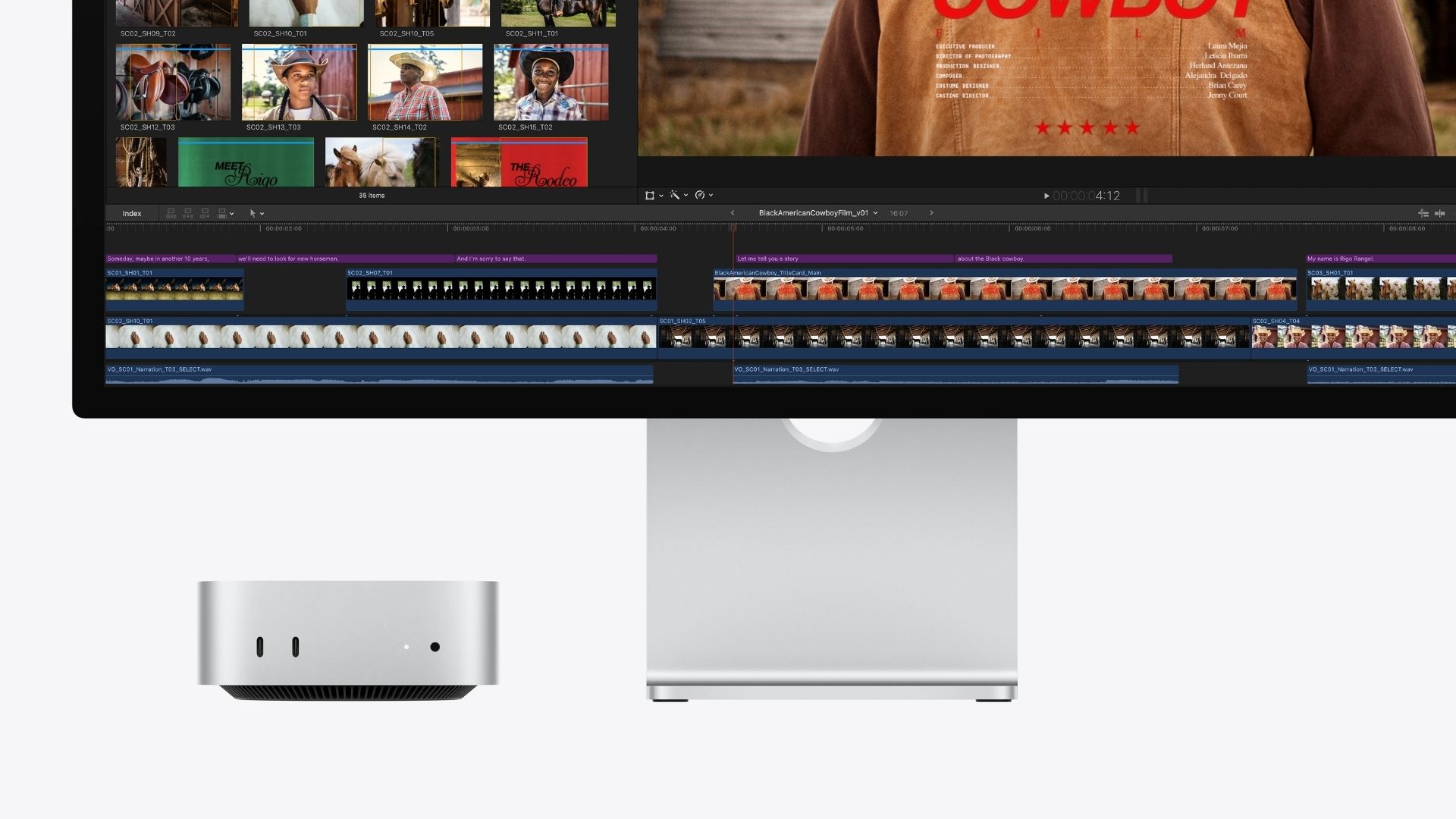
Apple’s new acoustic reports measure the 2026 Mac mini at 4 dB and the 2026 Mac Studio at 7 dB. Both numbers are A-weighted sound pressure at the operator position, roughly where you sit, and each holds for idle and for light web browsing on the one configuration Apple tested.

Those configurations matter. The Mac mini figure comes from an M5 Pro model with 48GB of memory and 8TB of storage, the Mac Studio figure from an M5 Ultra model with 96GB and 1TB, and neither report includes a heavy workload.
What Apple measured
| Measure | Mac mini (2026) | Mac Studio (2026) |
|---|---|---|
| Sound pressure level, operator position, idle | 4 dB | 7 dB |
| Sound pressure level, operator position, wireless web | 4 dB | 7 dB |
| Sound power level, idle and wireless web | 1.3 B (KV = 0.3) | 1.5 B (KV = 0.3) |
| Configuration tested | M5 Pro, 18-core CPU, 20-core GPU, 48GB unified memory, 8TB storage | M5 Ultra, 30-core CPU, 64-core GPU, 96GB unified memory, 1TB storage |
Apple declares the values “in accordance with ECMA-109,” a standard for reporting the noise that computer equipment emits. Its wireless web test “browses 6 tabs with a mix of content including media.” On both computers, idle and browsing produced the same numbers.
Don’t miss the best of The Mac Observer
Set us as a preferred source and our Apple reporting ranks higher in your Google Search results and Discover feed — one tap, no account changes.

Two measurements in two units
The dB figure is the one closest to what you hear at a desk. Apple defines it as “the mean A-weighted sound pressure level measured at operator position,” rounded to the nearest 1 dB.
The second figure is sound power, the total noise the computer radiates, and Apple gives it in bels (B), rounded to the nearest 0.1 B. Its footnote supplies the conversion, “1 B (bel) = 10 dB (decibel),” so 1.3 B equals 13 dB and 1.5 B equals 15 dB. That is a different quantity from the 4 dB and 7 dB readings, not a louder version of them.
KV is what Apple calls “the statistical adder for computing upper-limit of A-weighted sound power level.” Add it to the sound power figure and the upper limit comes to 1.6 B for Mac mini and 1.8 B for Mac Studio.
Why the Mac mini specs page says 5 dBA
Apple’s Mac mini tech specs page gives a different number: “Sound pressure level (operator position): 5 dBA at idle.” Its footnote says acoustics were “measured from typical operator position sitting in front of standard Mac mini system” and that “Acoustics may vary by configuration.”
The two Mac mini figures therefore describe different machines. The specs page covers a standard system, while the 4 dB report covers the upgraded M5 Pro build. The Mac Studio specs page lists no acoustic figure, so the 7 dB report is the only Mac Studio number Apple publishes.
What the reports leave out
Both tests are light: a computer sitting idle, and one browsing six tabs. Neither tells you how these desktops sound while exporting video, compiling code or rendering, which is the sustained work people buy an M5 Pro or M5 Ultra for.
Each report also covers a single build. If you are ordering an M6 Mac mini or a Mac Studio with M5 Max, Apple’s acoustic figures were not measured on your configuration.
Against the previous models
Apple’s tech specs for the 2025 Mac Studio list 1.6 B and 7 dB in the same two tests, measured on an M3 Ultra model with a 28-core CPU, 60-core GPU, 96GB of memory and 1TB of storage. The 2026 M5 Ultra model, with the same memory and storage, reads 1.5 B and 7 dB: sound power is 0.1 B lower, and sound pressure at the operator position is unchanged.
The 2024 Mac mini’s tech specs list 1.3 B and 4 dB, the same as the 2026 report. Apple tested entry builds that year, an M4 model with 16GB and 512GB and an M4 Pro model with 24GB and 512GB, and that specs page carried the same “5 dBA at idle” line.
Different chips, different configurations and rounded values mean these are not like-for-like comparisons. What they do show is that Apple’s published light-use figures for the new desktops are no higher than the ones it published for the models they replace.
Apple’s general sale date for both is September 22. If you are still choosing a chip, our Mac Studio M5 Max vs. M5 Ultra comparison and Mac buying guide cover the rest of the decision.


