
The UK competition regulator may impose tougher regulations on Google and Facebook over concerns about their dominance of online advertising.
Ex-Vox Media Man Will Lead Apple Podcast PR
Ex-Vox Media PR man Zach Kahn will lead for Apple podcast from early next year, and Apple has also hired Emily Ochsenschlager as a producer.

Facebook Thinks California Privacy Law Doesn’t Apply To It
The California Consumer Protection Act (CCPA) goes into effect January 1. Despite it being state-created it’s expected to affect all Americans. Some companies have been following Microsoft’s example and plan to voluntarily apply it to all states. Facebook however, disagrees (to no one’s surprise).
Facebook is taking a different tack for its web tracker, Pixel. Pixel’s name comes from its physical appearance on a website that installs it: literally, one square pixel. But behind that pixel is a code that that installs cookies on your browser, allowing it to track your activity across the internet.
Facebook provides this code to businesses free of charge, and those businesses can then purchase ads based off the information that Pixel collects…According to the Wall Street Journal, Facebook will claim that it doesn’t sell the data that its web trackers collect; it simply provides a service to businesses and websites that install Pixel on their sites. Because of this, it believes its web trackers are exempt from CCPA’s regulations…
How an iPad And a Laser Uncovered a Way to Hack Smart Home Devices
In spring 2018, cybersecurity researcher Takeshi Sugawara found that point a laser at an iPad’s Microphone converted the light into sound. Then, according to Wired, he discovered the same technique could hack smart home devices like the Amazon Echo and Google Home.
Sugawara pointed a high-powered laser at the microphone of his iPad—all inside of a black metal box, to avoid burning or blinding anyone—and had Fu put on a pair of earbuds to listen to the sound the iPad’s mic picked up. As Sugawara varied the laser’s intensity over time in the shape of a sine wave, fluctuating at about 1,000 times a second, Fu picked up a distinct high-pitched tone. The iPad’s microphone had inexplicably converted the laser’s light into an electrical signal, just as it would with sound. Six months later Sugawara—visiting from the Tokyo-based University of Electro-Communications—along with Fu and a group of University of Michigan researchers have honed that curious photoacoustic quirk into something far more disturbing.
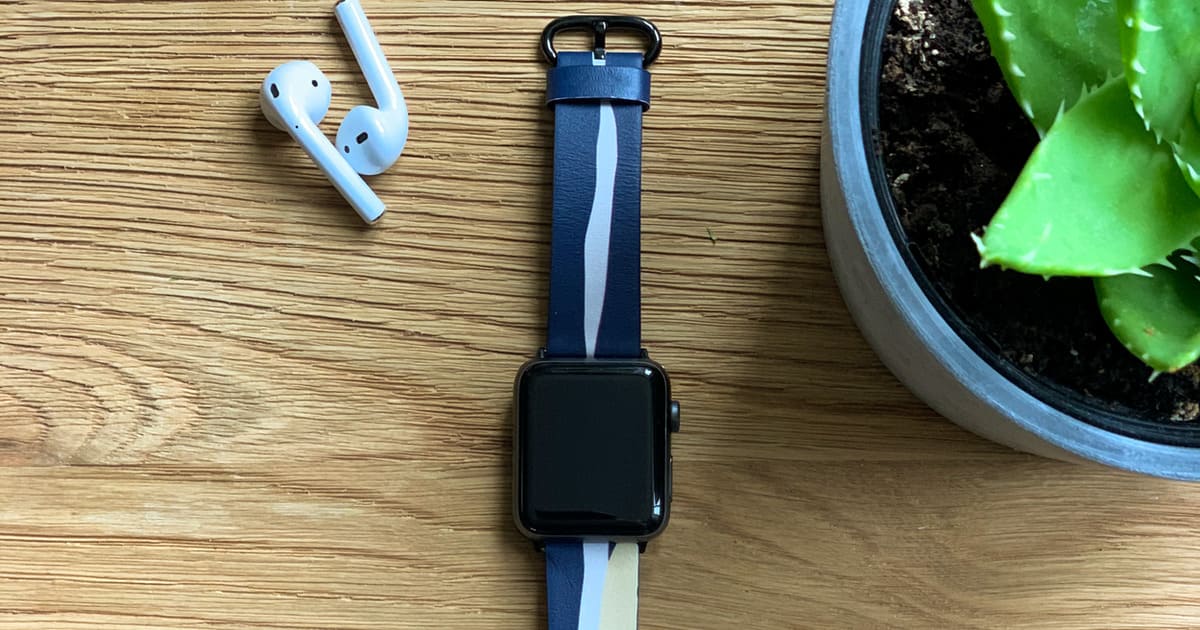
These Apple Watch Straps Are Helping The Planet
Icon Days has a new Apple Watch strap. Not only does it look stylish, but it is also helping protect the planet. The Navy Flame strap is made of premium of leather but it is also plastic free. That includes the packaging. Furthermore, 10% of profits go to environmental charities. The strap is compatible with all Apple Watch models. It costs £39 ($52) and there is free UK shipping in time for Christmas.

VICE Tests Amazon Ring’s Security, and it’s Not Good
Journalists at VICE tested the security of Amazon Ring security cameras, and they call it “awful.”
Ring is not offering basic security precautions, such as double-checking whether someone logging in from an unknown IP address is the legitimate user, or providing a way to see how many users are currently logged in—entirely common security measures across a wealth of online services.
Apple Removes ‘Rewound’ App That Made Your iPhone Look Like an iPod
Apple has removed the music app called Rewound that let people download skins to make the app look like old iPods.
To be fair, the iPod skins didn’t come pre-installed with the Rewound app—users had to download them separately once the app was installed. Though, you only have to look at tweets from users to see that the skins did in fact, look very much like the iPod Classic. However, Apple also reportedly took issue with the fact Rewound charged users for Apple Music features. Rewound says this was “less unreasonable” but noted that Apple had already approved in-app purchases before click wheel skins became popular.
”Less unreasonable.” I’d say that charging people for another company’s service is a big NO NO.

Apple Announces LGBT Documentary ‘Visible: Out on Television’
Today Apple announced that an LGBT documentary called Visible: Out on Television will premiere on its service February 14, 2020.

Walt Mossberg Looks Back on a Decade of Tim Cook
Apple journalist Walt Mossberg looks back at the past decade of Apple and how it fares under the leadership of Tim Cook.
Apple remains what it has been for many years: the single most important consumer tech hardware company, a major force not only in its industry but in society at large. And now, it is huge and rich to boot. But it’s still unclear if it can be anybody’s favorite music provider, TV network, or news service.
Or if it can launch another blockbuster device.

Power Up 3 Devices at Once with this 8,000mAh Hyper Charging Power Pack: $21.24
We have a deal on the HyperCharger PRO V.2 All-in-One Charger, an 8,000mAh portable battery with built-in Lightning and micro-USB cables, plus a USB-C adapter for charging those devices. It also has a USB charging port for plugging in a third device at the same time. It’s $24.99 through our deal, but coupon code MERRYSAVE15 brings it down to $21.24 at checkout.